

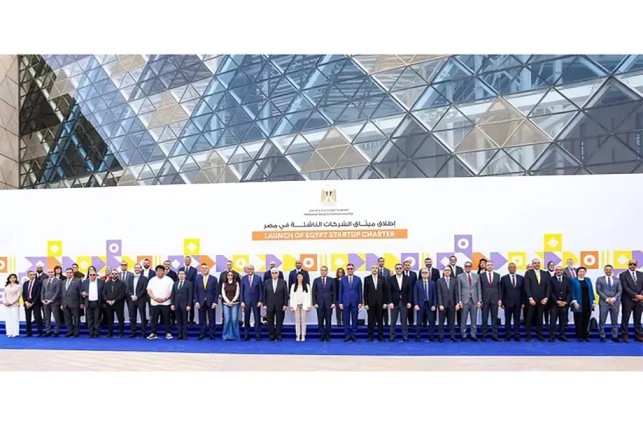
Cairo, Egypt — The Arab Republic of Egypt has officially launched “Egypt’s Startup Charter,” a landmark national framework aimed at strengthening the country’s startup ecosystem, mobilizing $1 billion in financing over five years, and enabling sustainable, innovation-led economic growth.
The Charter is the outcome of more than a year of extensive consultations involving 15 national entities and over 250 representatives from the startup ecosystem, including entrepreneurs, venture capital firms, support organizations, and members of parliamentary councils. The initiative was developed under the umbrella of the Ministerial Group for Entrepreneurship, marking a first-of-its-kind shift in how the government engages with startups and innovators.
The launch ceremony was held in the presence of H.E. Dr. Mostafa Madbouly, Prime Minister of Egypt, H.E. Dr. Rania Al-Mashat, Minister of Planning, Economic Development and International Cooperation and Chair of the Ministerial Group for Entrepreneurship, along with ministers, members of the Technical Secretariat, working groups, and ecosystem stakeholders. The announcement coincided with the 13th annual RiseUp Summit, Egypt’s flagship startup event.
A Strategic Roadmap for Egypt’s Startup Economy
“Egypt’s Startup Charter” serves as a five-year strategic roadmap designed to enhance the capacity of startups to contribute to economic growth, competitiveness, and job creation. Key targets include supporting up to 5,000 startups, creating approximately 500,000 direct and indirect jobs, accelerating regional and global expansion, reducing brain drain, and linking national challenges with innovative startup-led solutions.
At its core, the Charter focuses on coordinating entrepreneurship-supporting policies, maximizing the economic impact of startups, and encouraging innovation-driven growth based on knowledge and competitiveness.
Unified Definition of Startups
For the first time, Egypt has introduced an official, government-approved definition of startups, classifying them as newly established companies characterized by rapid growth, flexibility, and innovation, offering or developing innovative products, services, or business models.
This unified definition enables startups to obtain a classification certificate from SME authorities, allowing them to access incentives, facilitation measures, and government support programs more effectively.
Mobilizing $1 Billion Through a Unified Financing Initiative
According to Dr. Rania Al-Mashat, the Charter introduces a Unified Financing Initiative aimed at coordinating government financing resources and leveraging financial guarantees and co-investment mechanisms to multiply their impact by up to fourfold.
The initiative targets the mobilization of USD 1 billion over five years, combining government resources with investments from venture capital funds and private-sector financial institutions to stimulate startup growth and investment.
Empowering Scale-Ups and Creating Unicorns
Recognizing the importance of growth-stage companies, the Charter includes a Startup Scale-Up Empowerment Program designed to help mature startups expand, attract billion-dollar investments, pursue stock market listings or strategic exits, and scale regionally and internationally.
The program aims to leverage government tools and partnerships to support the emergence of new Egyptian unicorns, strengthening Egypt’s position as a regional startup hub.
Unified Startup Guide and Business Climate Reforms
To simplify regulatory navigation, the Ministerial Group for Entrepreneurship has developed a Unified Startup Guide that outlines all government services, permits, and licenses required by startups. The guide details applicable fees, documentation requirements, and issuance procedures, enhancing regulatory clarity and compliance while accelerating market entry and scaling.
The Charter also outlines structural reforms to improve the startup business environment in the short and medium term. These include simplifying tax procedures, easing liquidation and exit processes, expanding financing mechanisms such as crowdfunding, and conducting comprehensive studies to address regulatory challenges across priority sub-sectors.
Monitoring Progress Through an Entrepreneurship Policy Observatory
To ensure accountability and measurable progress, the Charter establishes an Entrepreneurship Policy Observatory responsible for collecting and analyzing data on policy implementation, investment flows, and ecosystem challenges.
The Observatory will issue periodic performance reports to support evidence-based decision-making and includes participation from startup ecosystem representatives. A Council of Elders, composed of experienced entrepreneurs and ecosystem leaders, will provide direct oversight and evaluation of progress.
A Living, Executable Framework
Dr. Rania Al-Mashat emphasized that “Egypt’s Startup Charter” is not a theoretical document, but a flexible and executable framework that will evolve in line with technological advancements and market needs. She noted that the Charter lays the foundation for updating Egypt’s startup-related policies and legislation through practical steps and clearly defined objectives.
It is worth noting that the Ministerial Group for Entrepreneurship was formally established by a decree issued by Prime Minister Dr. Mostafa Madbouly in September 2024, underscoring the government’s long-term commitment to fostering entrepreneurship, innovation, and job creation in Egypt.
https://startup.gov.eg/home
